What if our practice management software has no connection we can use?
The technical check says so at the start and the price reflects it. Usually the answer is a scheduled export. Occasionally it is a recommendation to leave that system out.
Practice management, time recording, the client ledgers, the portal and the inbox each hold part of the picture. Joined, and owned by you, they hold all of it.
A typical practice runs practice management software, a time system, a portal, a payroll product and a ledger for each client. Each one holds part of the answer to a simple question, and none of them holds all of it.
So somebody exports, somebody pastes, and a figure the partner asks for takes two days to produce and is out of date when it arrives.
Joining them is the first step and the one everything else depends on: the reporting, the automation, and eventually the valuation. A firm with clear figures sells for more.
What each system will give up, in writing, before anybody commits to a build. Some have a proper connection, some have a scheduled export, and a few have nothing. You find out in the first week.
Refreshed on a schedule into a database that belongs to the firm, using read-only keys you create and can cancel.
The same client under four slightly different names in four systems, matched once and kept matched.
Companies House, HMRC, payroll and your own internal dates, against every client, in a single list.
Once the data is joined, reporting and automation become small builds. Most of the cost of both is this step.
Your practice management system stays where it is. We build around it, because moving a whole practice onto new software is a far bigger job than joining what you have.
Buzz OS joins the client records, deadlines, jobs and messages for Andy's own firm in one system, now in testing. Its reporting, automation and client portal were all built on top of that first step.
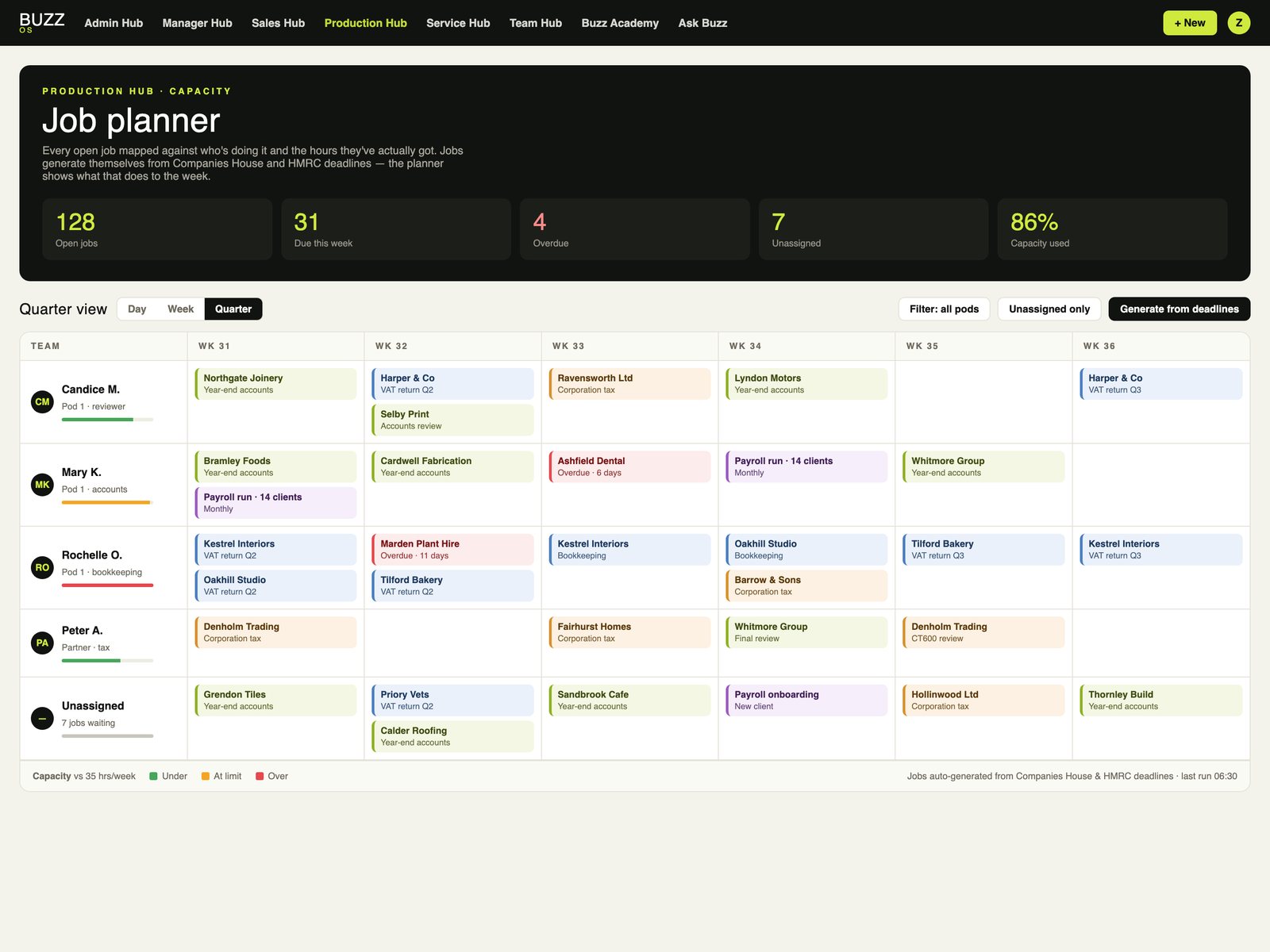
Twenty-plus modules, six AI agents and full HMRC Making Tax Digital filing, built to replace the separate tools an accountancy firm usually runs on. In testing ahead of ISO 27001 certification.
Read the case study →The technical check says so at the start and the price reflects it. Usually the answer is a scheduled export. Occasionally it is a recommendation to leave that system out.
Refreshed on a schedule, typically hourly. For a practice that is close enough to live, and much cheaper and more reliable to run.
It stays under your control: your keys, your database, your retention rules, and a log of everything that touched it. We put the data-processing position in writing before anything is built.
You keep the code and the data. There is nothing to move away from, because nothing was rented.
Tell us the job that keeps not getting done. We'll tell you if software can take it off you, and what it costs.