Case study · Acquisition Engine
Find, value and buy the accountancy firms worth owning
For firms buying accountancy, audit and tax practices. Set your brief and every firm in the UK is scored against it. See which owners are likely to be thinking about selling, work out an offer the funding can carry, run the deal room, and track the earn-out and the first hundred days after completion.
- 48,254
- UK accountancy, audit and tax firms in the universe
- 3,599
- on the statutory audit register
- 18,522
- firms where the oldest principal is 60 or over
- 8,266
- firms scoring 70 or more on the Succession Radar
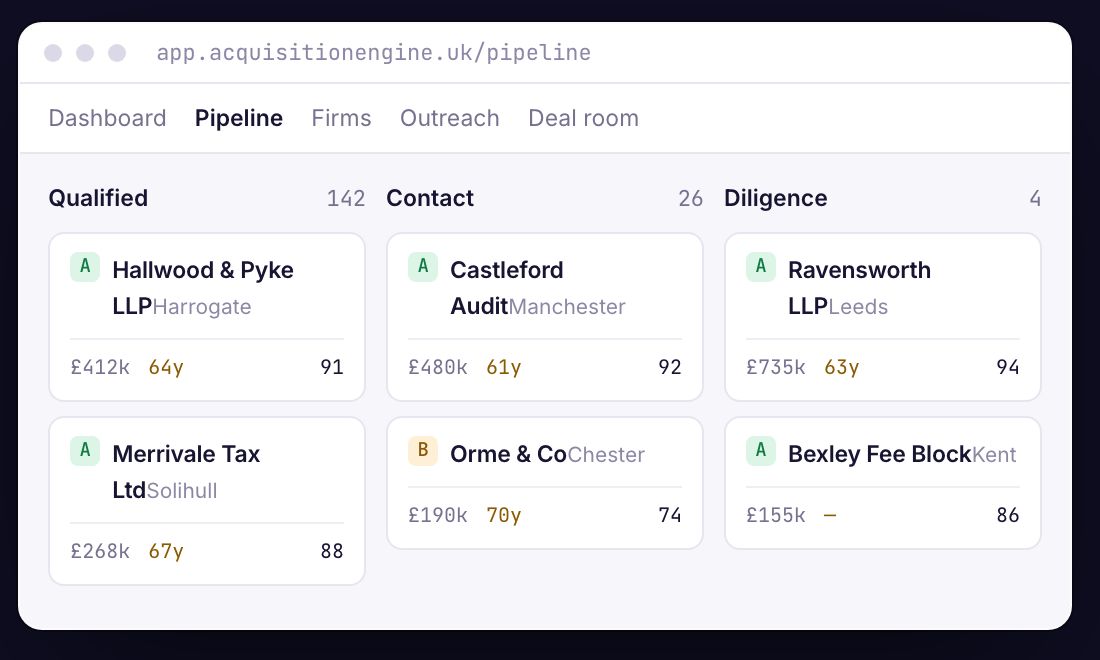
Figures from the Acquisition Engine database as at October 2026. The deal board is from the product's own site and shows fictional firms.
From buying brief to hundred-day plan
Every firm moves along the same stages. Long list to Contact are prospects. A deal starts at Evaluation, when the owner wants to talk, and the paperwork for each later stage opens when the deal reaches it.
- Strategy
- Long list
- Qualified
- Contact
- EvaluationThe owner wants to talk
- OfferDeal room opens
- DiligenceRequest list issued
- Sale agreement
- CompletionHundred-day plan opens
- Integration
- Review
Step 1
Set the buying brief
Tell it what you are buying: the size of firm by fees, the region, whether you need a registered auditor, and the deal type, from a whole-firm share purchase to a fee bank. Every firm is then scored against that brief, with the reason for each score and the reason for each exclusion.
The universe holds 48,254 accountancy, audit and tax firms, plus 10,871 financial advice firms: 59,125 in all. Run more than one brief side by side and the judgement on each firm is kept per brief.
- Size
- Gross recurring fees from £300k to £1m
- Region
- Yorkshire and the North East
- Audit
- Not needed
- Deal type
- Share purchase or fee bank
- Principal aged 67, past usual retirement age
- No principal under 55, so nobody obvious to hand over to
- Sole principal
- Established 31 years
- Files the smallest accounts it can
Step 2
See which owners may be ready to sell
The Succession Radar scores every firm from 0 to 100 on the signs that an owner may be thinking about an exit: the principal's age, no principal under 55, resignations, and how the firm files. Each firm shows the reasons behind its score, so you can judge every one.
Principals' ages are known for 53,895 firms. In 18,522 the oldest principal is 60 or over, and 8,266 firms score 70 or more.
Step 3
Shortlist the firms and make the approach
Shortlisted firms move from Long list to Qualified to Contact. Letters and emails are written for each firm in your voice, sending is paced, and every approach is checked against suppression lists and the Privacy and Electronic Communications Regulations first. Replies land back on the firm's record.
Contact details are confirmed against a primary source for 2,026 firms. Everything else is left blank on purpose: you get one approach to a practice owner, and a wrong address spends it.
- Audit register
- Not registeredStatutory audit register
- Principal age
- 67Companies House officer records
- Website
- Proved to belong to the firmChecked against the firm's own domain
- EmptyNot confirmed, so left empty
- Phone
- EmptyNot confirmed, so left empty
Step 4
Work out an offer the funding can carry
The offer explorer starts from the profit in the accounts and walks to maintainable earnings line by line. Each adjustment is marked hard, soft or contested, so the ground you will negotiate over is in plain view. It then gives an opening, a target and a ceiling, solved from what the funding can service, and shows what the seller keeps after tax. The fee multiple comes last, as a check.
| Operating profit per the accounts | 142,000 | |
|---|---|---|
| Owner's pension the buyer will not pay | Hard | +36,000 |
| Office move, a one-off | Soft | +12,000 |
| Market salary for a replacement principal | Hard | −60,000 |
| Spouse's salary for no role in the firm | Contested | +18,000 |
| Maintainable earnings | £130,000 |
Hard case £118,000Seller's case £208,000Contested line not counted
Business Asset Disposal Relief is 18% on the first £1m of lifetime gains for disposals from 6 April 2026, and gains above that are taxed at 24%.
Step 5
Run the deal room and diligence
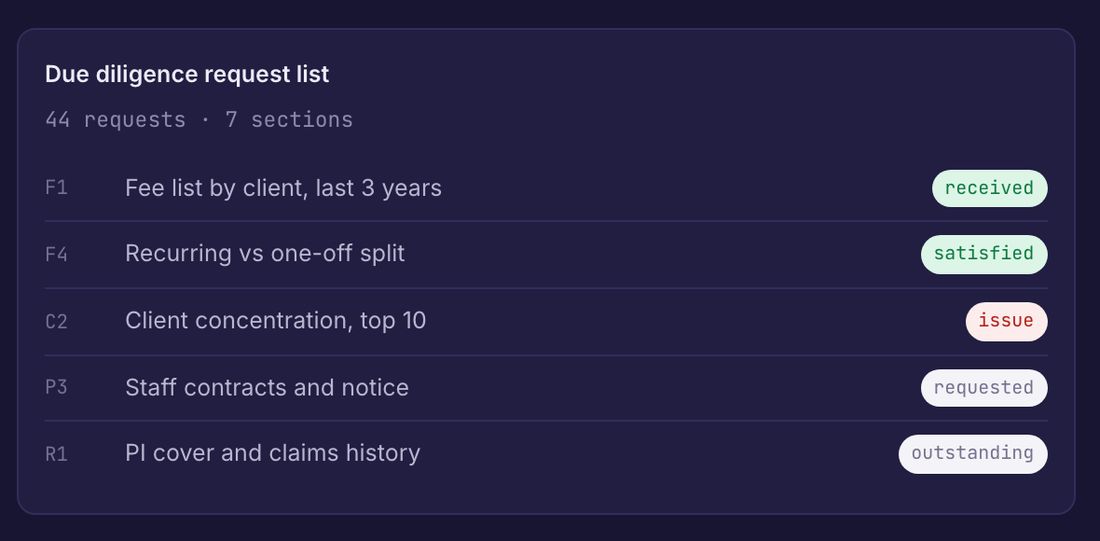
The data room opens at Offer and the request list at Diligence: nine folders and forty-four requests, each with guidance on what to look for and a risk rating. You decide document by document what the other side sees, and every view and download is logged against the user and the deal.
Step 6
Bed the firm in after completion
Each bought firm joins the buy-and-build portfolio. Earn-out instalments are tracked as due, at risk, paid or clawed back, and a hundred-day playbook of 19 items in three pillars opens on completion day.
- Completion payment£372,000Paid
- First instalment, month 12£124,000Due
- Second instalment, month 24£124,000At risk
- Clawback for clients lost in year one−£9,400Clawback
Modernise
Move the firm onto the platform.
- Every client on a cloud ledger, with bank feeds on
- Digital records ready for Making Tax Digital
- A client portal live for every client
- Practice management onto the group system
- Identity verification recorded for every director
- Website and content onto the group engine
Consolidate
Take the cost and the risk out.
- Every client's fee reviewed against the group price card
- Engagement letters reissued on group terms
- Direct debit for every recurring fee
- Back office moved to the group
- Money-laundering, insurance and data protection on one policy set
- Work allocated by team capacity
- Premises decision made, with the lease dates in hand
Grow
Earn more from the clients you bought.
- Payroll and pensions offered to every employer client
- Management accounts offered to larger clients
- Financial planning introductions live
- A referral programme with the firm's own clients
- The next acquisition nearby identified from the Succession Radar
- Year-one review against the offer