Which systems can you read?
Practice management, time recording, the ledgers your clients use, and your own accounts. The technical check at the start sets out what each one will give up: a connection, a scheduled export, or nothing.
Client packs produced without a partner rebuilding a spreadsheet, and a clear view of the practice's own recovery, work in progress, lock-up and fee mix.
Every practice has two reporting jobs, and usually only one gets done.
The first is client management accounts. They are useful and chargeable, and they are often rebuilt by hand each month in a spreadsheet that lives on one person's laptop.
The second is the firm's own numbers: recovery by job, work in progress, lock-up, which clients make money and which services carry the others. The fee income is easy to find. The rest sits in three systems that have never been joined.
Produced on a schedule from the ledger, in your own template and branding, ready for the partner to check and add the commentary.
Time recorded against what was billed, so the jobs that lose money become a list with names on it.
Unbilled time and unpaid invoices tracked together. Together they show what the practice is owed.
The share of income from compliance, advisory, payroll and one-off work, and which way each is moving. Buyers look at this first when a practice is sold.
Fees set against the hours spent, including the client who rings four times a week.
The six figures that matter, refreshed overnight, on a single page that is quick to read.
Buzz OS was started because the numbers that run a practice were spread across four systems and a spreadsheet. Its reporting is the reporting Andy wanted for running the firm. It is in testing now, ahead of ISO 27001 certification.
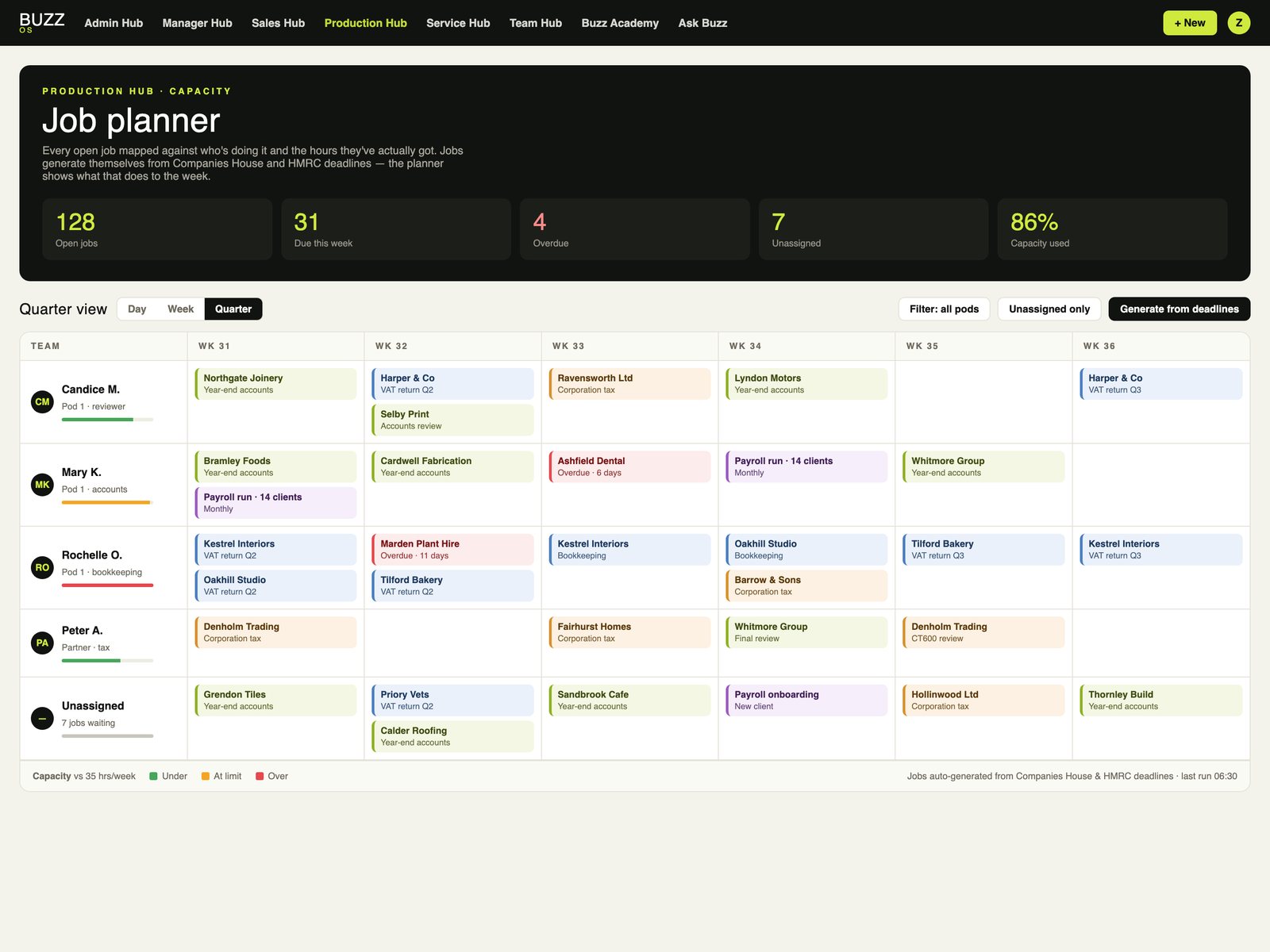
Twenty-plus modules, six AI agents and full HMRC Making Tax Digital filing, built to replace the separate tools an accountancy firm usually runs on. In testing ahead of ISO 27001 certification.
Read the case study →Practice management, time recording, the ledgers your clients use, and your own accounts. The technical check at the start sets out what each one will give up: a connection, a scheduled export, or nothing.
Recovery and client profitability need time records. Fee mix, lock-up and debtors do not, and those three on their own tell you a lot.
It can be. Often it doesn't need to be. What matters is that the data is joined and belongs to you; the screen on top is whichever one your team will open.
You do, along with the code. That is the point of building it for you.
Tell us the job that keeps not getting done. We'll tell you if software can take it off you, and what it costs.