Do we have to replace anything?
No. Nothing gets ripped out. We read from what you have and build around it, which is cheaper, faster and far less disruptive than a migration.
Your accounts, till, shop and job software joined into one place that belongs to you — so a question can be answered without three exports and an argument about which total is right.
Every interesting question in a business spans systems. Which customers are most profitable needs revenue, cost to serve and discount — three places. Are we about to run out needs stock, sales rate and inbound orders — three more.
That's why the answer is usually a spreadsheet and a spare evening. We build the layer that makes those questions answerable properly: one database, holding your data, with the identities resolved and the definitions agreed.
We establish exactly what each of your systems will give up — API, scheduled export, or nothing — before you commit to anything. Occasionally the answer is 'not much', and you find that out at the start.
Only what changed since last time, so refreshes stay cheap and can run hourly forever rather than hammering your software nightly.
The same customer under three different names becomes one entity, with a decision about which system owns the record going forward.
One written line per term, because most reporting disagreements turn out to be undeclared definitions rather than bad data.
Each piece of information has one owning system and flows outward from it. Two-way sync is where integration projects go to die.
A heartbeat, so a sync that stopped in March doesn't get discovered in June.
Companies House, HMRC's Making Tax Digital APIs, Xero, Google Workspace, e-signature, direct debit and AML — all joined inside one platform built for our own firm.
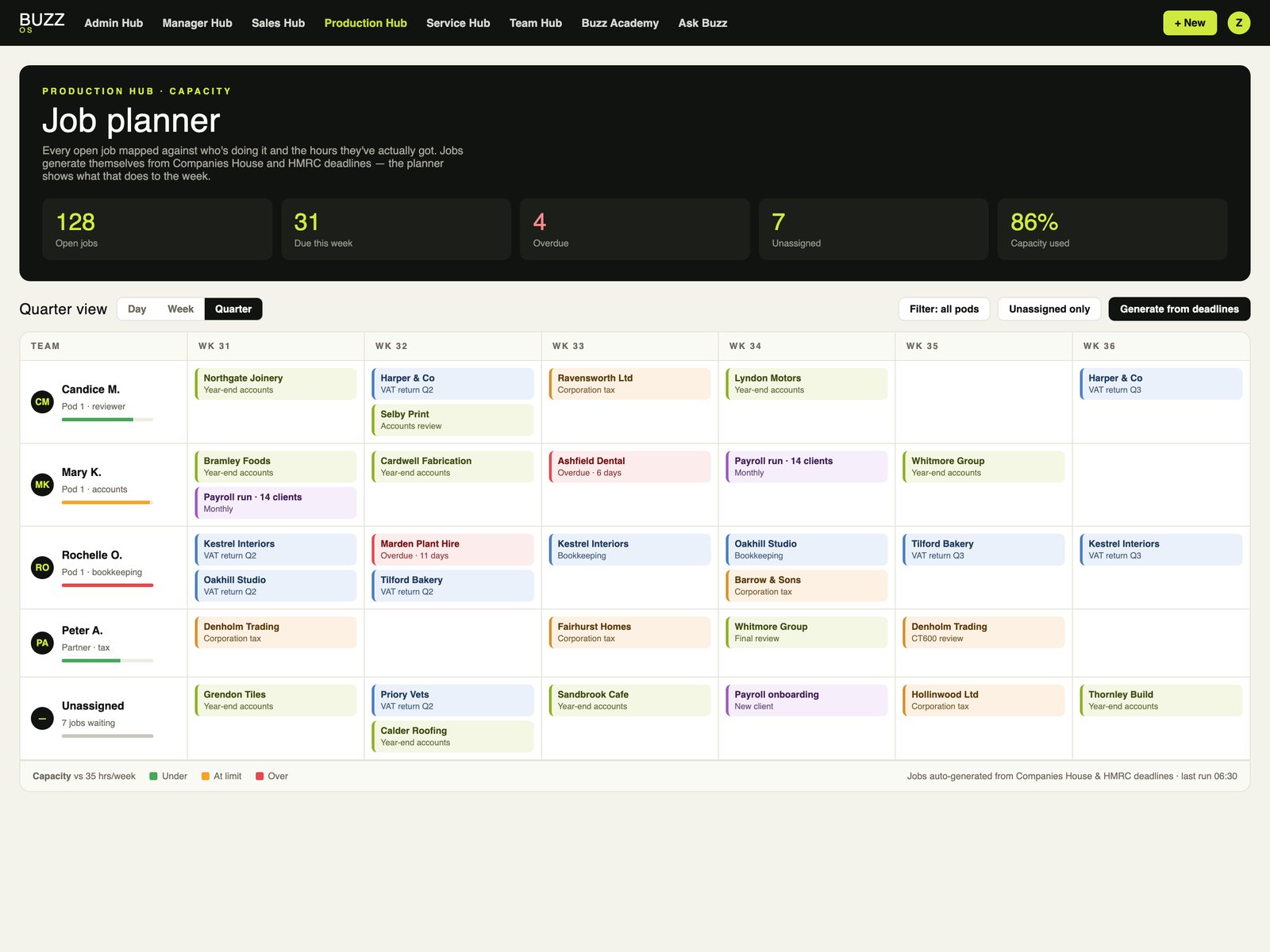
Twenty-plus modules, six AI agents and full HMRC Making Tax Digital filing, built to replace the separate tools an accountancy firm usually runs on. In testing ahead of ISO 27001 certification.
Read the case study →No. Nothing gets ripped out. We read from what you have and build around it, which is cheaper, faster and far less disruptive than a migration.
By default, yes — with keys you create in your own account and can revoke in one click. Write access is only added for something you specifically asked for, like creating a draft order.
In a database in your name that you keep. If you stop working with us, you keep the hub, the history and everything built on it.
Then we say so early and pick deliberately between reorganising around it, shrinking the manual step to a file drop, or replacing it. What we won't do is scrape a system that doesn't want to be read — that breaks silently at the worst moment.
Depends entirely on how many systems and how cooperative they are. You get a date with the quote, after the audit, rather than a guess beforehand.
Tell us the job that keeps not getting done. We'll tell you if software can take it off you, and what it costs.